Showing posts with label Articles. Show all posts

Tune into Channel(s)...

      In honor of #ThrowBackThursday, here’s a story about winter fishing at Deckers, Colorado.   It faired to be my favorite river to frequent in the cold, and I often found myself among snow and ice.  Actually… from November to February, through nearly 10 trips (all successful in landing trout), I was always standing in snow or on ice.  In a state full of fly-fishermen like Colorado, it’s nice to find yourself alone on a few trips.  Sub-zero temperatures will certainly lead to smaller crowds.

      These temperatures certainly add challenges not experienced in the green spring.  Frozen eyelits, difficulty reaching the holes, and complete numbness of the hands are a few of these challenges.  But hey, the trout don’t care how cold you are.

      Perhaps the most important practice in winter-fishing in Colorado is bringing warming agents such as hand-heating pads and whiskey.  Second to that, exploring the entire river.  Likely, the fish are near motionless in the deepest channels where food still reaches their hungry mouths.  But it may take some time and experimentation to find these channels.

      Due to a fisherman’s pact, I’m not at liberty to disclose the exact location of this “money-hole”.  But I will say this:  I’ve never seen this area fished by anyone but myself - This hole offers a glorious overhead vantage from its access point, and on clear days you can see these channels carved by moss and rock. Lastly, they really seemed to love small Black Beauties and Black RS2s.  These flies pulled fish in the double digits – none were a shameful size - throughout my winter excursions.


      This winter, prepare wisely (flask of Canada’s finest distilled, perhaps), dress warm, and get out there.  In the very least, you’ll have an adventure that few will share.  And when you find those channels, you’ll find yourself lucky.

Read More »

Attacking Arkansas - More Than Just Trout (Striper)

      Arkansas is truly a dream destination for flyfishermen.  It doesn't have the same sex appeal as Florida, Montana, Colorado, or Alaska, but it is truly a fly fishing mecca in its own right.  Consider this: Arkansas is home to the world record for brown trout in the four-pound-line class, the world record walleye in the twelve-pound-line class, the world record hybrid striped bass, the world record ozark bass, and the world record shadow bass.  The TOSFly team has caught three of these species: brown trout, walleye, and hybrids.  The others are in the sunfish family, and we just simply haven't pursued them yet (though we will). My point is simply that Arkansas truly is a destination fishery, and we believe it is one of the best kept secrets in the country.  Because of that, we are going to take a daily look at some of the various species this hidden gem has to offer, beginning with the Striped Bass.


STRIPED BASS - The Fish

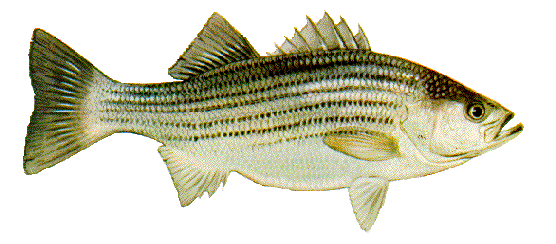
The Striped Bass, or "striper," is one of the most avidly pursued of all fresh water sport fish. Striped Bass Fishing was first introduced to Arkansas in 1956 when Lake Ouachita received twenty-seven North Carolina Stripers.  Fifty-eight years later, striper fishing is one of the fastest growing sport fishing segments in Arkansas.  Most of that draw is directly attributable to the size of the fight, which is exponentially exacerbated by fighting them on the fly.  Some say that fly fishing for striped bass is the only way to pursue them.  We at TOSFly tend to agree.

The Striped Bass is the largest of the popular gamefish family called Temperate Basses, which also includes Hybrid Striped Bass and White Bass. While White Bass seldom exceed 4 lbs. and Hybrid Stripers rarely exceed 20 lbs, Striped Bass live much longer and commonly reach the 30-50 lb range.  On Bull Shoals Lake in February of 2012, Rodney Ply of Diamond City, Ark. caught a mammoth striped bass that weighed 68 pounds lakeside!  They are out there, you just have to find them.

This is not to downplay the fun in catching White Bass and Hybrids.  When the White Bass run in March and/or April each year, you better believe the TOSFly team will be the water pulling them in.  It really is an amazing experience to catch those fish, but that is another post for another day.  Back to stripers.

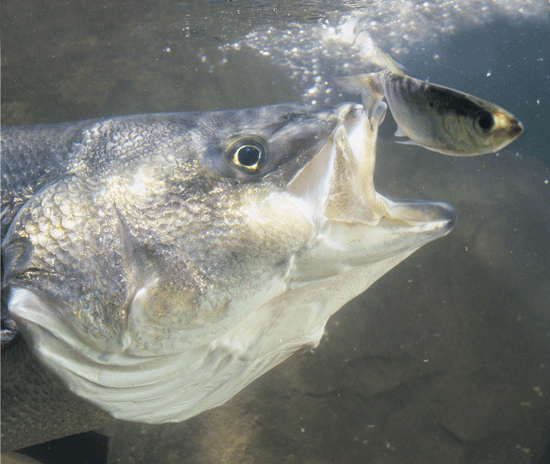
Striped bass are native to the Atlantic coastline of North America. Like Salmon, these fish are anadromous, which means they migrate between fresh and salt water, with their spawn taking place in fresh water.  They have been introduced into many of the large reservoirs across Arkansas by the state game and fish commission for recreational fishing and as a predator to control populations of shad.  This includes Lake Ouachita, Lake Norfork, Beaver Lake, Lake Hamilton, and several other reservoirs in Arkansas.

LOCATION - Where To Go


The Natural State offers up plenty of opportunities when it comes to doing battle with mammoth stripers and world-class hybrids.  Here are just a few of the hot spots:

Beaver Lake - Jumbo stripers are the main attraction at Beaver Lake, which spreads over 28,220 acres in the Ozark Mountains. Over the years, this lake has given up its share of 40-pound-plus stripers. During the spring, the fish are scattered throughout the lake, but by the time July and August roll around, you can bet on finding these big game fish in the deeper areas of this deep lake.  The stripers make a distinct run up the lake’s two main arms during March and April in an attempt to spawn, and in the summer most fish are within about six miles of the dam, where the best deep-water habitat is found. During May, however they might be just about anywhere.


Norfork Lake - Lake Norfork is one of the best fresh water striped bass fisheries in America. The Arkansas Game and Fish Commission has been stocking Lake Norfork with stripers every year for almost 30 years. The average striper here weights about 16 pounds, with the lake record weighing in at a little over 50 pounds. Fish over 40 pounds are caught every year, and is is fairly common to hook up with a 30+ pound fish. Fish population counts continue to show large, healthy populations of striped bass feeding on Lake Norfork's shad. There are plenty of trophy striped bass here to be caught, and there is plenty of time to do it on the fly. The lake never freezes so you can catch these lunkers year round, you just have to know how to do it right!

Ouachita Lake - Ouachita Lake is also one of the cleanest freshwater lakes found in the entire United States, and it offers great striper fishing. The lake’s hatchery is no longer used for stocking stripers because the Arkansas’ Game and Fish Commission has moved to truck releases, which can produce more accurate stocking numbers. But, that doesn’t mean the fishing is anything less than topnotch. In 2010, the recommended striper-stocking rate was two fingerlings per acre of water — or around 80,000 fingerlings per season for Ouachita Lake.

Arkansas River - Stripers can be found from the Oklahoma border to the Mississippi River in the Arkansas River, a distance of 310 miles. However, most fish are concentrated in the tailwaters of the 12 dams that divide the river into pools.  While the Arkansas River does not produce many trophy fish, fish up to about 20 pounds do show up pretty regularly, and fish in the 5- to 15-pound range tend to keep fishermen very busy. Finding fish is easier than it would be on vast reservoirs for most anglers because the stripers concentrate in a dozen fairly limited areas.  This tends to help when pursuing these fish on the fly.

Greers Ferry - Greers Ferry Lake contains some monster fish! The lake still holds the world records for two species of fish - walleyes and hybrid stripers. The walleye record is a hefty 22 pounds, 11 ounces. In addition, a 27-pound, 5-ounce hybrid striper was caught by Jerry Shaum of Shirley back in 1997.  Both fish records are still world records, and it is clear that this fishery is one of a kind! Generally, Greers Ferry Lake hybrids will mostly be found over the big-water areas of the lake toward Heber Springs.  You can generally catch them on anything that resembles a shad, so match your fly to what size shad you see in the schools you locate.

FEEDING - What They Like

There are signs of active stripers all across Arkansas fisheries.  The presence of bait fish is typically the most obvious tell-tell sign, and is definitely the most important indication that stripers are active and willing to take your fly.  Look for circling birds as they oftentimes work in tandem with the stripers, attacking baitfish from above and below.  You'll see birds in the sky coupled with the tail spacking action of the stripers as they run the shad to the surface.

Certain times of the year, you won't be able to miss the activity.  Other times, it will seem almost non-existent.  Don't give up.  Just continue to pursue them, and eventually you will have success, and it will be worth it.  Savvy anglers will be there when the feed is on, which happens more often in the summer just above the thermocline in 25- to 30-foot depths, all the way up to the surface.  To Arkansas fishermen, the month of June is one of the best times of the year to be fishing for stripers, but the fish can be deep at that time, which makes it difficult for fly fishermen.  The best time of year for us is likely mid- to late-spring. Just remember that stripers like cloudy weather — and the worse the weather, the better the bite.  Catch them during their spawn run and before they head deep.  If you are able to do that, you should have the fight of your life on the fly!


EQUIPMENT - What To Use
The best rod for use in fishing for stripers is an eight -weight with a strong bass leader.  Use white and blue streamers across the subsurface to imitate pooling shad.  A neutrally buoyant fly and presentation usually works best when going after these behemoths. Most of the time, we fish a sink-tip or sinking head fly line and use rather heavy and/or bulky flies.  As they say, a big fish calls for a big fly!

One of the most important factors for success is choosing and using the right fly lines for the given opportunity and conditions.  For surface and near surface conditions, a floating or intermediate fly line is needed to present floating, diving, and shallow sinking patterns.  For depths greater than 3', we recommend a sinking line.  You can choose a variety of different "types" of sinking line based on the depth you are pursuing.  This will depend on the time of year and conditions you fish.  Again, consider the opportunities your fishery presents and the conditions available before purchasing your line.


TIPS - How It's Done
Local knowledge can't be beat, so find a good tackle shop that specializes in fly fishing and find out where they have been biting and on what kind of bait, if not the actual fly pattern.  From there, I will leave it up to you.  Try it out, and post in the comments if you have success!  As always, cast to The Other Side!

Read More »

Happy July 4th - Big Thompson River

Those of us that live in Colorado know that the Big Thompson River recently experienced a giant renovation.  What was called “the 1000 year flood” ripped through a few months ago, leaving a path of devastation.  I don’t know the biology of fish well enough, but given the destruction I witnessed on my drive up – I assume it altered their feeding patterns significantly.

It truly is a tragedy, what happened to the surrounding areas.  It will take years to repair the damage – while some may be irreversible.  The fishing, however, has begun to rebound.

If you’re looking for scenic and serene, the Big Thompson is not the river for you.  Amidst catching beautiful trout, I was actively drowning-out the screaming children and whipping go-carts in the amusement park.  Nevertheless – it was all beautiful in its own right. 


The fish were rising all day, as well as feeding subsurface.  The only successful area was between the Lake Estes Dam and the first private-property bridge.  I stuck to the same setup all day – Yellow Foam Grasshopper with a size 20 Grey, Bead-Head BWO Emerger.  No weight, 6x fluorocarbon tippet.  I caught several great rainbows throughout the late afternoon – some on the BWO, some on the Hopper.  What was most encouraging… they were rising to the hopper all day!  Slightly discouraging that I missed most of the hook-sets, but it’s been a while since I’ve fished top water.

If you’re looking for a quick trout-fix-trip out of Denver – head to the Big Thompson.  The fish are rising!  And the go-carts aren’t the worst soundtrack…when you’re catching fish.

Read More »

Colorado Rivers & Runoff

      Of all the rivers to be fished in Colorado, Cheeseman Canyon has proven to be one of the most difficult.  While its picturesque beauty is hard to overlook, the towering and daunting canyon walls and winding, roaring river is not the only intimidating factor when setting out to fish this classic Colorado waterway.  Part of the difficulties lie in the undulating 1.5 mile hike from the river’s main access point.  Then, once reached, it’s often another couple miles walk to jump the crowd of anxious anglers to find a solitary point to make a first cast.  And unless you find that pool where a school of trout are holding, there’s typically a continual hike to stay ahead and pursue some level of success.

      Fortunately, those pools can be found.  So can that success. 


      My most recent trip to the Canyon was greeted with treacherously high water – due to the annual season of snow melt.  As always, I kept hiking to find some separation from other anglers.  Between steps on a slippery, narrow walkway, I glanced at the river for any signs of feeding.  In between massive fallen boulders in a series of whitewater shoals, I noticed the glimmering of rolling and rising fish.  In an effort to give an athletic impression of myself, I’ll say I ‘ran’ down… but it was really more like sliding.

      When I was near enough to make a cast, I noticed an astonishing number of fish piled on each other in a small side-pool next to the rapids.  Hard to explain in words alone, these fish were feeding from currents coming up underneath their resting place.  My only theory was that the boulder was just deep enough to disrupt the flow, but not cut it off entirely.  The current was slowed, and was essentially “boiling” up from underneath.  With the level of the water, and the rate at which it roared, these trout has an incredible amount of food at their disposal. 

      It took a while to find the right depth, but after posting myself on the highest boulder - I used high-sticking to drift my size 16 Stone Fly with size 20 brown Miracle Midge dropper through the boils.  Admittedly, I’m usually very impatient and move locations within an hour, at best – but this pool was so intriguing, I fished for 6 hours on that boulder.

      With the water clear-as-super-clear-water, I watched that 21 inch rainbow roll into my Miracle Midge with flawless precision, coming from several feet below.  After entering the shallowest point of the pool, still chest-deep, and fighting for 15 minutes – the trout ended in my net.  My biggest advantage and disadvantage was the 6x fluorocarbon line at the end of my leader.  I truly believe this amount of stealth was necessary to lure the fish, but it took a heavy dose of delicacy to land.


      If you haven’t made it out to Cheeseman, do your bucket list a favor and go.  It’s gorgeous and difficult, and the rewards can prove to be great.  Look for pools and unusual flows to explore.  Definitely use enough weight when the water is high and fast.  

And, of course, Cast to the Other Side.


Read More »

Slack Water - An Encouraging Word


TOSFly readers, please consider this a small word of encouragement from one impatient angler to others.  While fly-fishing is tranquil and serene, I often get very excited in the days, weeks, and months leading up to a much needed trip to the river.  That anticipation builds even before I decide to head to the stream.  It is building now as I look forward to the TOSFly annual retreat next weekend.  


I always assume perfect conditions, dream of my flawless performance, and lose count of the monsters I’ll catch just as soon as I slip on my Gore-Tex.  My wife is a mental health therapist, and I therefore feel I am qualified to diagnose myself.  I have a common fisherman’s illness called “Assumptive Bad-Assery Disorder."  You're probably familiar with it, and you may even have it yourself.  Fairly self-explanatory, this disorder leads me to believe I’m going to break every record that’s ever been imagined by any angler in the history of history.  It’s easy to build these 20-pound stories while I’m in the office.  The problem lies, however, when I make my first cast and a monster trout does not end up in my net.  “What am I doing wrong?”  I curse myself… I’m doing everything I assumed I should…

Typically, after my first five minutes of failure, I decide it’s the fly or the section of river – and I change.  I change something, or everything.  And the pursuit of monsters continues throughout the frustration-filled day, all the while I'm blaming everything but myself.  Of course, I’m awesome – a "bad ass" if you will."  Surely it can’t be my fault…

Assumption and anticipation are great things, but patience truly is a virtue.  While it may seem obvious, there probably are fish in that hole.  They probably will eat that fly – or at least one of the few I've set out for that day.  I've learned that I need to move less.  Lately, I've had more success when I fish the entire stretch of a river.  Starting in the shallow banks, working out towards the main drift, then across to #TheOtherSide (see what I did there?).  If that doesn’t work, try another shelf.  Put on another weight (or take some off), raise (or lower) the indicator, and experiment in the drifts.  Those fish are stacked somewhere. 


If you’re like me, and you’re tempted to move at a moment’s “loose-fly-line,” take a breath, and re-position your fly.  If they’re not holding in the main drift, they could be deeper.  If they aren't deep, perhaps they’re relaxing in the slack water.  It is much better to be skunked knowing you fished every inch of water than just a few “good runs.”  You may just end up with that monster… or at least end up less tired.  Just remember one thing - Cast to the Other Side!

Read More »

Annual TOSFly Trip

It's almost here.  The annual TOSFly fishing trip.  As you can tell, it has been quite some time since we last posted to this blog.  In fact, from what I can tell, it has been about 3 years.  But today is a new day.  We are at the dawning of a new era, and it starts on June 25, 2014, when our group meets on the Little Red River in Arkansas.  Stay tuned for updates from that trip!

I did some scouting last weekend, and the fishing was good.  My father-in-law and I caught a couple dozen rainbows a piece, and the browns were active too!  But, Arkansas has experienced a TON of rain over the past week, which will affect the flow substantially in early June.  Nonetheless, with any luck, the poor weather conditions will be out of here by the time our trip rolls around.  Here's a little snippet of what the river had to offer last weekend before the rain moved through.  Let's hope it only gets better as the weeks pass!


Until next time, cast to The Other Side!!!

- Seth

Read More »

The New J-Ferg Bench (ORDER ONE NOW!!!)

Inevitably, when you start fly-fishing, you will soon begin to feel the urge to start tying your own flies. And so the journey of learning how to tie those delicate size 22 BWO's and the articulating circus peanut begins. As most tiers progress, they begin to get particular about their tying setup, tools, and desk. This definitely sums up my journey as a tier.

Seth, AKA the Prez, got a very nice fly-tying bench from Oasis for Christmas, and this thing is nasty. After seeing it, I decided to take on the task of building my own bench in an attempt to save some scrilla. Below, you will see my creation. Though it is not 100% complete, it was a fun project to cure my fishing blues.

All the materials you see in the pictures below are from Walmart and can be purchased affordably. The tools I used consisted of a skill saw, screw gun, chop saw, and a little bit of sweat. See my step by step process below:

I bought 2 TV trays from Walmart 

I started by deconstructing both TV trays by removing the legs

I used a skill saw to rip one of the cutting boards into 3 pieces, 2 side trays, and one box tray for the back

I used the leg material of the TV tray stand to prop the sides up and screwed them to the base tray

Both side trays are installed, and hey, I even used the screws that came with the TV tray! Resourcefulness! How about that!

I installed the back box tray, then used a dark walnut stain to cover my cut edges ...

And believe it or not TOSFly readers, all this was done for a VERY reasonable cost! All I have left to do is layout my holes for wood dowels to hold thread, and the holes for my tools!

It doesn't take a rocket surgeon to build one of these, you just have to be creative and have fun! I loved doing this project because I built a fly-tying table that fit my needs. I encourage you to try building your own! Or, if you don't feel up for it, just shoot us an email and you can order a custom table from TOSFly! Contact us for pricing! Either fill out the contact form, or shoot us an email at info@TOSFly.com!

Until next time ... Cast to The Other Side!

- J-Ferg

Read More »

Little Red Winter Trip

Last weekend, as many of you know, the TOSFly crew packed up their gear and took off for the Little Red River outside of Heber Springs, Arkansas. The crew included J-Ferg, Brett Ferguson (AKA B-Ferg), Chud, The Prez, Dean Rose (AKA Deano AKA the Prez's Pops-In-Law), and Deano's friend Bill Ray (AKA Wild Bill). We had an absolute blast fishing and just kicking it at the cabin. We spent hours at night discussing technique and strategy. The TOSFly crew sends out a special thanks to Deano for generously allowing us to crash at his amazing place. Here's a pic of good old Deano for you:

Deano with a nice brown caught at Cow Shoals

For those of you who have not visited the Little Red, you need to put this place on your fly-fishing bucket list. When they are not generating, the river becomes very small and shallow at most wadable fly-fishing shoals. We had to change our nymphing techniques for very shallow, fast-moving runs as well as semi-deep, stagnant water. The name of the game during the winter months on most trout fly fisheries is slow and small. Everything gets smaller in the winter, and this should include your leader, tippet, and flies. Most trout become lethargic during the cold winter months, and their feeding habits change. We caught the tail end of what seemed to be a late season brown trout spawn. Although there were no visible redds, a couple of the browns caught were depositing eggs as we netted them.


We spent most of the weekend nymphing with small (size 18-22) red asses and midges. The key to success for us was not using ANY split shot. The water was shallow and slow enough to forego the use of weight. The absence of split truly helped the fly get a more natural drift into the feeding lanes. We tried pulling streamers in some of the deeper pools, but we only seemed to land small stocker rainbows. Much of our pulling came up empty handed.


The Little Red is an extraordinary fishery. You can truly see the difference in stocked brown trout and naturally reproduced browns. All the fish that we caught over the weekend were full of life and put up a hard fight. If you want to land a trophy brown trout, the Little Red is hands down the place to go! Now, enjoy a little photo foursome for your viewing pleasure:


Until next time,

Cast to The Other Side!

Read More »

5 Tips for Successful Winter Fly Fishing


If you're a die hard fly-fisherman like me and the fellas at TOSFly, you can't help but eat, drink, sleep, and dream about fly-fishing. When you are so passionate about something, you can't go without it for 4-6 months out of the year while the snow falls and the flows drop. You have to find ways to go out and fish the winter water to catch some fish!

The problem with winter fishing is that it is completely different from any other time of year. With temps dropping and flows at all time lows, the fish are less apt to feed, and they are easier than ever to spook. When you sight a fish in the summer, you match the harch, throw a good cast, and hook the fish. In the winter, there is no hatch, and the fish are on the bottom, barely moving. These big guys will let the fly hit them in the face before they will even think about eating it. 

Here's the good news. WIth the right technique and a change in your normal fishing routine, you can catch some of the biggest fish of the year; and you will land them with greater success then other times of the year, namely summer.

I'm going to give you 5 tips to help you catch trout during the winter. So, read this over, bundle up, grab your de-icer and nymphing box, and go catch that HOG!!!
  • Fish with more weight
It's a common mistake for most fishermen to not fish with as much weight as they should. In the winter, those fish are not willing to move. You will have a tough time finding the fish during the winter if you're not on the bottom. Weight you fly taking into consideration the depth and current, then adjust your leader accordingly. Because the water is typically warmer neat the bottom, the fish cling to the bottom, and weighting your fly will put it in the strike zone where it needs to be.
  • Fish with longer leader
It's typical in Colorado to fish with only a 7.5 to 9 foot leader. However, in the winter I would highly recommend fishing with nothing less than a 10 foot leader. I personally prefer the 12 ft. 6X leaders, and I have fished some up to 16 feet. I do this for several reasons. First, the flows are typically lower, and the fish will be spooky. Using a longer leader will help your presentation. Secondly, it is important to set your rig deeper when winter fishing. I have fished my rig as deep as 7 feet before and pulled some pigs out of it. Fishing with a longer leader will help you get to those type of fish.
  • Fish SLOW, I mean VERY SLOW
I have fished the same hole for an hour, and caught nothing on my first 500 casts. Then, on number 501, that 18-inch brown finally decided it was hungry and took a bite out of my midge. Maybe all those casts simulated a hatch, maybe I made the perfect cast that set the fly in his house, either way, fishing slower and working every inch of the water will help make the difference between a successful day, and a cold one.

  • Fish smaller flies
Simply said, pretend everywhere you fish during the winter a tailwater. Sizes 18 to 26 are the flies I am talking about here. If you need to buy old man glasses, don't feel bad. It is tough to thread those small midges when it's 15 below and your hands don't seem to be working. Small midges, san juan worms, egg patterns, scuds, and streamers are 99% of the active food in the water at that time. Using these patters but going up 2-3 sizes will be the ticket. The winter weather doesn't allow for the growth of larger bugs, and the fish know that and stay keyed in on those smaller patterns.
  • Watch that indicator

It's just the cold (sometimes VERY cold) hard fact that not every fish is going to feed during the winter. A lot of times you will see a fish, spend all day casting to him, and the big guy doesn't take a single thing. He just sits there, and you have to foul hook him in the mouth to land him (which is really not fishing in my opinion). If the fish do eat, it is just a slight movement and an opening of the mouth. You will not see the indicator go under water as your line screams out; instead, you will see a slight hesitation in your indicator. It will look exactly like your fly got stuck on the bottom for just a quick second and then return to normal. If that happens, set the hook; you probably have a fish.


My final piece of advice is this: if there is a hatch, fish it! You rarely will have a better time dry fly fishing than on the right day in the winter when the trout are rising to those wonderful blue-winged olives ever so gingerly. It is a real joy and rarity to experience, and it is a moment that our wonderful God blesses us with only on the rarest of days.

So find a local tailwater, or any stretch of open water for that matter, remember what your friends at TOSFly told you, and get out and fish!!!

Float Em high,

Dry Fly or Die --- Allen Gardner

Read More »